The Game is Rigged: A PHuncle’s Guide to Health Equity

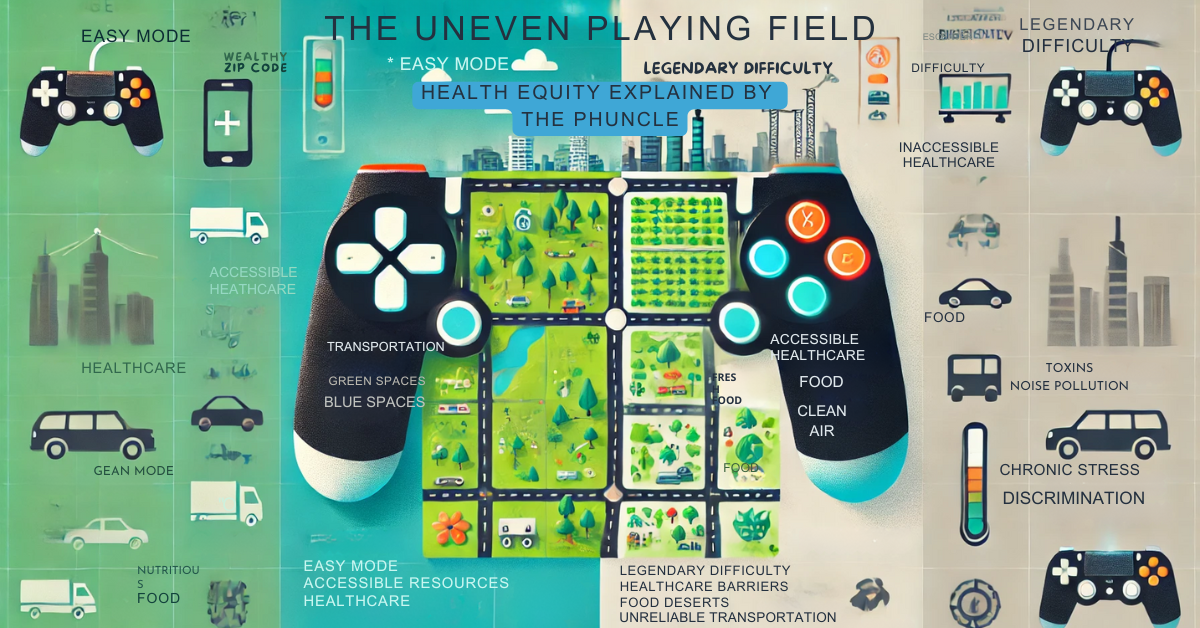
Look, lemme tell you something bout Health Equity: Health Equity is like a video game, but not everybody’s playing the same version. Some folks out here playing on “Easy Mode” with all the cheat codes and power-ups they could need. Meanwhile, others are stuck on “Legendary Difficulty” – you know, where one hit takes out half your health bar, and the healing stations are few and far between.
I remember the exact moment this hit different for me. I was in undergrad, working on a paper about maternal health for my Medical Anthropology course when the stats knocked me back: The United States is out here spending more on healthcare than ANY other country in the world, but our maternal mortality rate is higher than any other developed nation – and it’s getting worse.
And let me tell you, these numbers ain’t hitting everybody the same way. Depending on who you are and where you live, your odds of making it through childbirth healthy can be dramatically different. That’s not just a skill issue – that’s a system issue.
That’s what we call health inequity, and trust me, it’s not a glitch – it’s a feature of the system. When you dig deeper, you see how these maternal health outcomes connect directly to where people live. Same game, different difficulty settings based on your ZIP code(among other thing).
But here’s the thing: once you understand how the game is rigged, you can start working on changing the rules. And that’s exactly what the PHuncle is here to break down for you.
In this guide, we’re gonna explore everything from how your starting point affects your whole gameplay to why some players seem to have unlimited resources while others are struggling to maintain their health bar. More importantly, we’re gonna talk about how we can patch this game to make it fair for everybody— the core of Health Equity.
Before we dive in deep, let me make something clear: this isn’t about giving everybody the same health potion. This is about understanding why some players need more healing than others, and making sure everyone has a fair opportunity to level up.
Let’s get into it.
Level 1: Understanding the Game Settings
Listen, if you’ve ever played a game, you know the first thing it asks you is to choose your difficulty setting. But in this health game? That choice gets made for you before you even hit start.
Think about it like this: Some players spawn into a world with high-end gaming setups— clean air, fresh food on deck, parks everywhere, doctors in walking distance, good schools, and low-stress levels. That’s your “Easy Mode” right there.
But for too many people, especially in our Black and Brown communities, the game loads up on “Legendary Difficulty” automatically. Their spawn point comes with:
- Air quality dropping their health stats daily
- Food deserts limiting their healing items
- No healing stations (healthcare) in sight
- Environmental hazards everywhere
- Limited save points (preventive care opportunities)
- Higher damage from everyday encounters (cumulative chronic stress)
The Tutorial Level: What is Health Equity?
Now, a lot of folks hear “equity” and think it’s just another way to say “equality.” These are not the same.
Equality is giving everybody the same health potion, regardless of their damage level. Sounds fair, right?
But what if one player has full health and another is down to their last heart? Why are we even giving a health potion to someone at full health? They can’t use it, don’t need it, and meanwhile, that other player is one hit away from game over. That’s wasteful game design right there. Those resources could’ve gone to the player actually fighting for survival.
That’s where equity comes in. Health equity means understanding that different players need different levels of support to reach full health. It’s about:
- Getting more healing stations in health desert areas
- Directing resources to where they’re needed most
- Removing barriers that keep certain players from accessing power-ups
- Rewriting the game’s code to give everybody a fair chance
Level 2: The Game Mechanics (Social Determinants of Health)
Resource Distribution
Y’all ever played a game where some areas have all the shops, supplies, and resources, while other areas are just… empty? That’s exactly how our health system is set up right now.
Let’s break down these game mechanics:
Food Access:
Picture this – you need to restore your health, but the only shops in your area are selling items that drain your health bar slowly over time. That’s what a food desert feels like. Sure, you technically have “choices,” but when the nearest fresh food vendor is three bus rides away, and the only quick options are convenience stores and fast food, what kind of choice is that really? The structure constrains your agency.
Transportation (Fast Travel Points):
Some players got fast travel unlocked – hop in their car, straight to the doctor’s office, no problem. Others? They’re playing on hardcore mode where getting to one appointment means:
- Taking off work (losing coins)
- Catching three different buses (time penalty)
- Hoping the schedule lines up (pure chance if it works out)
- Praying it doesn’t rain (try waiting for a bus in the cold, holding groceries)
Healthcare Access (Healing Stations):
Ever notice how some areas got healing stations on every corner, while others don’t have any for miles? And even when you find one, you might not have enough coins to use it, or maybe it doesn’t accept your type of currency (insurance). That’s not just bad game design – that’s by design.
Education (Skill Points):
Education in this game works like skill points – the more you have, the better you can navigate the health system. But here’s the thing: some players start with a fully upgraded skill tree because of their ZIP code, while others are trying to level up with limited resources and outdated information.
Environmental Factors
Now let’s talk about how your spawn location affects your entire gameplay:
Air Quality:
Some players take environmental damage just by breathing—that’s their default state. We’re talking about neighborhoods next to highways, industrial zones, landfills, and pollution sources. Their health bar is constantly ticking down, while other areas have clean air buffs.
Green Spaces (Rest Areas):
You know how games have safe zones where you can recover and reduce your stress meter? That’s what parks, walking trails, and green spaces do in real life. But check the map – these recovery zones ain’t distributed equally.
Safe Neighborhoods (Safe Spawn Points):
Your stress meter matters. When you’re constantly on alert because your spawn point isn’t secure, your health stats take a hit. Chronic stress is like having a constant drain on your health that affects every aspect of your gameplay.
Housing Quality (Base Stats):
Your home base should be where you recover and rebuild your stats. But for too many players, their housing is causing status effects like:
- Asthma triggered from mold
- Sleep penalty from noise pollution
- Stress multipliers from housing density
- Health drain from poor insulation
Here’s the real talk: none of these mechanics exist in isolation. They’re all connected, creating compound effects that can either boost your gameplay or make it nearly impossible to progress.
And just like any game, if the mechanics are broken, no amount of “just do better” or pulling yourself up by your bootstraps, or simply working harder is gonna fix it, and victim-blaming sure ain’t helping.
Level 3: Understanding the Meta (Systemic Issues)
Historical Context:
Listen, to understand why the game is rigged today, we need to look at who wrote the original code, nah mean?
Redlining (Restricted Map Areas)
Back in the day, they straight up took whole areas of the map and marked them as “no-go zones” for certain players.
Banks wouldn’t give loans, insurance companies wouldn’t provide coverage, and resources wouldn’t flow to these areas.
The practice might be illegal now, but the map restrictions? Those effects are still in play.
That’s like having your character start every new game with negative stats because of where your grandparents’ character had to live versus continuing progress from your ancestors’ high score.
Discriminatory Policies (Rigged Rule Set)
The original game developers wrote rules that deliberately gave some players advantages while holding others back. Think about it:
- Some players couldn’t access certain healing stations
- Certain areas were zoned for environmental hazards
- Educational resources were distributed unequally
- Healthcare research excluded certain player groups
These weren’t glitches – they were features of the original game design.
Generational Wealth (Inherited Inventory)
Some players start the game with their inventory already filled with resources passed down from previous players. Others start with empty pockets and system-imposed barriers to collecting resources. When your starting gear affects your ability to maintain your health bar, that’s not just about individual gameplay – that’s about system design.
Medical Mistrust (Damaged Player-NPC Relations)
When the healing stations have a history of harming certain players instead of helping them, you can’t just patch that with a quick update.
That trust damage carries forward through generations. Now we got players avoiding healing stations altogether because the history of how the game treated their ancestors is still fresh.
Current Systems
Insurance (Pay-to-Win Mechanics)
Let’s keep it a buck: the current health system is running on pay-to-win mechanics. Got premium currency? Full access to healing stations.
Working with basic currency or none at all? Good luck finding a station that’ll accept your payment type.
And even with insurance, some players still gotta solve a whole puzzle just to figure out what’s covered.
Digital Divide (Limited Server Access)
In 2024, health resources are increasingly moving online, which is great. But what happens when some players:
- Can’t afford the equipment to connect
- Don’t have reliable internet in their area
- Never got the tutorial on how to use these systems
- Can only access services through a small phone screen
Language Barriers (Communication Filters)
Imagine playing a complex game where all the important information is in a language you’re still learning. Now, add health decisions to that mix. We got players out here trying to navigate crucial health choices through:
- Google Translate (assuming they have devices with that function)
- Their kids interpreting (which may mean pulling them out of school)
- Incomplete information
- High-stakes misunderstandings
Cultural Competency (Character Class Understanding)
Too many healing stations are operating without understanding different player types. They’re using a one-size-fits-all approach when we know different communities:
- Have different healing traditions
- Process health information differently
- Face unique environmental challenges
- Carry different historical experiences
The meta of this game needs a serious update, fam.
But here’s the thing – once you understand how these systems were built, you can start seeing ways to change them.
And let me be crystal clear: these health barriers weren’t created by nature or chance – they were designed by people, which means people can redesign them.
Remember: Every single one of these barriers was socially produced. They didn’t fall from the sky or grow from the ground – they came from policies, practices, and decisions made by actual people.
And what humans build, humans can rebuild. That “this is just how it’s always been” excuse? We’re not accepting that anymore.
And that’s exactly what we’re gonna talk about next – how we can rewrite these rules together.
Level 4: Player Strategies (Community Solutions)
Individual Actions
Now, let me be real with you – individual players shouldn’t have to carry the weight of a broken system. But while we’re working on changing the game itself, here are some strategies to help you level up and protect your health stats:
Preventive Care (Armor Upgrades)
Think of preventive care like upgrading your armor before the big boss fight. Regular check-ups, screenings, and vaccinations? Those are your basic protection stats.
Yeah, the system might make these harder to access for some players, but knowing they exist and how to find them? That’s your first power-up.
Health Literacy (Skill Development)
The more you understand about health, the better equipped you are to navigate the system. It’s like learning the combo moves in a fighting game:
- Know your rights as a patient
- Understand your health numbers
- Learn to read nutrition labels
- Question what doesn’t make sense
- Keep records of your health journey
Advocacy (Team Buffs)
Your voice matters, and it gets stronger when you combine it with others. Learn to:
- Speak up about your health needs
- Connect with community organizations
- Share knowledge with your squad
- Support others in their health journey
- Document what’s not working
Resource Navigation (Map Knowledge)
Knowing where to find resources is like having a detailed game map:
- Community health centers
- Sliding scale clinics / FQHC (Federally Qualified Health Centers)
- Transportation assistance
- Food support programs
- Mental health resources
Team Strategies (Community Action)
But here’s where it gets good – when players team up, that’s when real change starts happening.
Community Organizations (Guilds)
Community organizations are like guilds in an MMO – they’re where players come together, share resources, and tackle bigger challenges. These groups:
- Pool knowledge and resources
- Create support networks
- Share survival strategies
- Build collective power
- Fight for system changes
Policy Advocacy (Pushing for Game Updates)
Remember what I said about these systems being socially produced? That means we can push for better game rules:
- Attend community meetings
- Contact your representatives
- Join advocacy groups
- Support health justice initiatives
- Share your story
Coalition Building (Squad Assembly)
Different players bring different skills to the team. When we build coalitions, we’re creating a squad that can:
- Combine different types of knowledge
- Share resources across communities
- Create stronger support networks
- Generate more pressure for change
- Protect vulnerable players
Resource Sharing (Inventory Management)
Look, some of us might have access to resources, but others don’t. That’s when we need to think like a team:
- Share information about programs and services
- Help others navigate the system
- Connect people to resources
- Organize community support networks
- Create mutual aid systems
Here’s what’s beautiful about team strategies – they build power beyond individual actions. When we coordinate our moves, suddenly we’re not just playing defense against a rigged system – we’re actually changing how the game works.
And that power to change the game? That’s what we’re gonna explore in our next level.
Level 5: Changing the Game (Systems Change)
Policy Solutions
Alright, let’s talk about how we patch this game at the system level. Because individual players and even guilds can only do so much when the core game mechanics need updating.
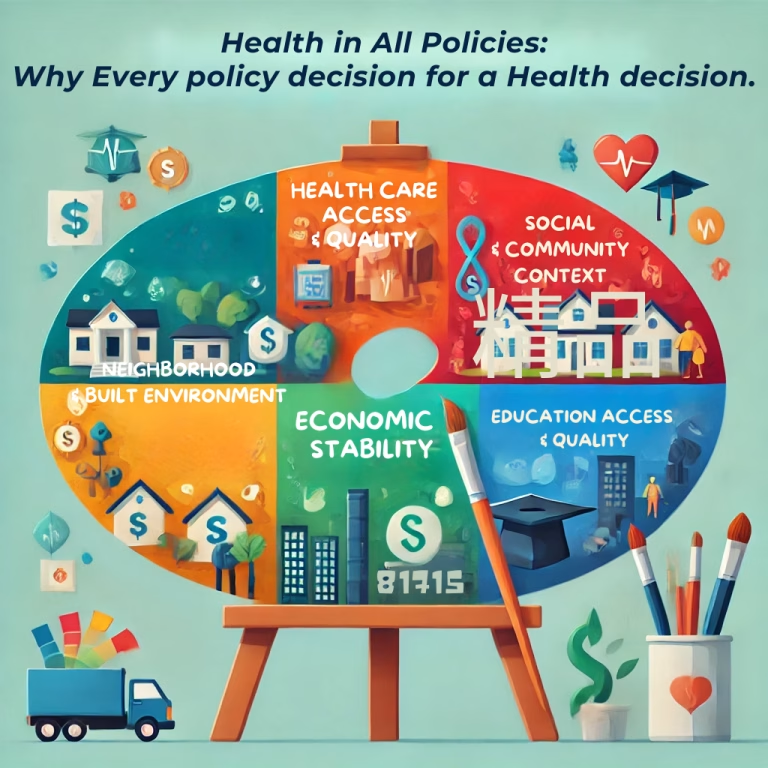
Health in All Policies (Universal Game Balance)
Imagine if every policy update had to consider its health impacts before dropping. Whether we’re talking about:
- Housing development
- Transportation planning
- Education funding
- Economic policies
- Environmental regulations
Every single update needs to answer the question: “How does this affect players’ health stats?” That’s not just a good idea – it’s essential for fair gameplay.
Universal Healthcare (Equalizing Access to Healing)
Let’s just call it what it is: having health tied to what kind of currency you hold or where you work is a broken system.
And before someone jumps in with the “but that’s socialism!” battle cry, let your PHuncle hit you with some game stats:
Remember, we’re spending more coins than ANY other player nation on healthcare, but our survival rates are in the gutter. Make it make sense!
That’s like having the most expensive gear in the game but still getting wiped out by basic enemies.
And let’s address these classic boss-fight arguments:
“But I want choice!”
My friend, what choice? Your employer hands you a pre-selected menu of healing potions (if you’re lucky enough to have that), tells you which healing stations you can use, and still hits you with random damage costs.
Meanwhile, other nations with universal health systems are out here letting players choose their healers AND paying less for better outcomes.
“The wait times, though!”
Please, try getting an appointment with a specialist right now – they’ll tell you spin the block 6 months from now.
We’re already waiting; we’re just paying premium prices for the privilege.
Here’s the wildest part – about 35% of American players are ALREADY using government health systems through Medicare and Medicaid. That’s right – we’re already running a partial socialist healing system, and guess what? The world didn’t end!
The cherry on top – in countries with universal healthcare, you can STILL get private insurance if that’s your jam!
That’s right, these nations said “why not both?” You want the universal basic healing system?
Bet.
You want to pay extra for premium options? Go for it!
But let’s talk about this mindset for a minute.
Some players are really out here choosing to take damage themselves just to make sure other players don’t get healing. That’s like refusing to use a health potion yourself because you’re mad that someone else might get one too.
Who does that help? While you’re busy blocking other players from getting care, you’re also blocking YOURSELF from better options.
The game isn’t zero-sum, dawg. Someone else getting healthcare doesn’t mean you get less – it means we ALL level up together.
Environmental Justice (Map Rebalancing)
We need to rewrite the code that’s allowing some areas to be dumping grounds for environmental hazards while others get all the green spaces. This means:
- Clean air requirements for all zones
- Fair distribution of green spaces
- Removal of toxic spawn points
- Protection for all player communities
- Resources for environmental cleanup
Educational Equity (Tutorial Access)
Knowledge about health shouldn’t be locked behind paywalls or ZIP code barriers. We need:
- Health education in all schools
- Community health worker programs
- Cultural competency training
- Accessible health information
- Multiple language support
Community Power
But here’s the real talk – these changes don’t just happen because they make sense. They happen when players organize and demand better.
Grassroots Movements (Player-Driven Updates)
The most powerful updates often come from players who got tired of dealing with broken mechanics:
- Community organizing
- Direct action
- Policy Advocacy
- System accountability
- Power building
Leadership Development (New Player Support)
We need to build up the next generation of players who understand both the game mechanics AND how to change them:
- Youth leadership programs
- Community health training
- Advocacy skill building
- Political education
- Movement building skills
The power move here? Understanding that we’re not just players in this game – we can be the developers too.
Every major health justice win came from communities coming together and demanding change. From clean water requirements to workplace safety standards, it was organized players who made it happen.
Remember what we said about these systems being socially produced? Reminder, that means they can be socially RE-produced.
We can rewrite this game’s code. We can change the rules. We can create new systems that actually serve all players.
But first, we gotta know what moves to make. And that’s what we’re getting into next with our Final Boss section.
The Final Boss: Taking Action
Look, now that we understand the game mechanics and how they’re rigged, it’s time for the boss fight. But remember – this ain’t a solo mission. This is a raid, and we need everybody’s skills to win.
Personal Level
First, let’s get your character build right:
Stay Informed (Knowledge Build)
- Follow health justice organizations
- Sign up for policy alerts
- Learn about local health issues
- Keep up with community needs
- Share what you learn with your squad
Use Your Voice (Communication Skills)
- Speak up about health injustice
- Share your story
- Challenge harmful myths
- Support others speaking out
- Document what’s broken
Build Your Network (Alliance System)
- Connect with health advocacy groups
- Join community organizations
- Find your people
- Support mutual aid networks
- Share resources
Community Level
Now, here’s where the real power-ups happen:
Get Organized (Squad Goals)
- Join local health justice organizations
- Attend community meetings
- Support grassroots movements
- Build coalitions
- Create action networks
Push for Change (Boss Fight Strategies)
- Contact your representatives
- Attend policy meetings
- Support health justice legislation
- Vote for health equity
- Hold systems accountable
Remember, the final boss isn’t really a single enemy – it’s a system of barriers, policies, and practices that keep health equity locked away.
But here’s what makes this winnable: We know exactly how these barriers were built, which means we know exactly how to tear them down.
And look, I know it can feel overwhelming. Trust and believe, I know it can be overwhelming.
The health system’s got more layers than a bean dip.
But remember – every major health victory we’ve ever had came from regular players who got tired of the game being rigged and decided to change it.
The PHuncle’s gonna keep it 100: This is a long game.
We’re not talking about a quick side quest – we’re talking about changing the whole damn game. But that’s exactly why we need you in it.
Because at the end of the day, health isn’t just about individual players – it’s about all of us.
Every time we make the game more fair for one player, we make it better for everybody. Every barrier we break down opens paths for others. Every victory we win becomes a spawn point for more victories.
So what’s your next move? Whether you’re ready to join a raid party for major system change, or you’re just starting to learn the controls, there’s a role for you in this fight. The only wrong move is staying on the sidelines thinking the game can’t change.
Remember: These health barriers were socially produced, which means they can be socially dismantled. The game is rigged – but together, we got the cheat codes for justice.
Ready, player? Pick up that controller and headset, and let’s lock in.
Resource Guide (Bonus Content)
Organizations to Level Up With
National Players
- National Health Law Program (NHeLP) – Legal warriors for health justice
- Prevention Institute – Specializing in systemic health solutions
- PolicyLink – Masters of health equity strategy
- Right to Health Movement – Health justice squad
- Human Impact Partners – Data and research power-ups
Local Support Guilds
- County Health Departments
- Community Health Centers
- Local Health Equity Coalitions
- Food Justice Organizations
- Housing Rights Groups
Tools for the Journey
Health Equity Assessment Tools
- CDC’s Health Equity Guide
- WHO’s Health Equity Assessment Toolkit
- Robert Wood Johnson Foundation’s Health Equity Tools
- PolicyLink’s Health Equity Tools
- Prevention Institute’s Health Equity Tools
Knowledge Power-Ups
- County Health Rankings & Roadmaps
- Health Affairs (Health Equity Focus)
- NIHCM Foundation Resources
- Kaiser Family Foundation Health Disparities
- Healthy People 2030 Resources
Community Organizing Guides
- Building Healthy Communities Toolkit
- Community Tool Box (University of Kansas)
- Health Equity Guide for Public Health Practitioners
- Racial Equity Tools
- Social Justice Leadership Resources
Emergency Resources (Quick Access)
Immediate Support
- Crisis Hotlines
- Emergency Food Resources
- Housing Assistance
- Healthcare Navigation Services
- Mental Health Support
Remember: These resources aren’t just links – they’re power-ups for your health justice journey. Don’t feel like you need to use them all at once. Save this guide, level up gradually, and reach out to the PHuncle if you need help finding the right resource for your situation.